Scaling Telemedicine Programs After Successful Pilots
Introduction to scaling telemedicine programs
Telemedicine has emerged as a transformative approach to healthcare delivery, enabling patients to access medical services remotely through video consultations, telephone calls, remote monitoring, and secure digital communication. Successful pilot programs have demonstrated how virtual care can improve access to healthcare professionals, reduce travel burdens, support continuity of care, reduce cost for health systems and community, and make healthcare services more convenient for patients. However, the success of a pilot does not automatically translate into a sustainable, large-scale program.
Scaling telemedicine requires a strategic approach that extends beyond technology deployment. Healthcare organizations must address clinical workflows, infrastructure, workforce readiness, reimbursement, regulatory compliance, patient engagement, and long-term financial sustainability. The objective is not simply to increase the number of virtual consultations but to integrate telemedicine into routine healthcare delivery while maintaining quality, safety, equity, and patient satisfaction.
This article explores the key strategies, challenges, and practical considerations for scaling telemedicine programs after successful pilot implementation.
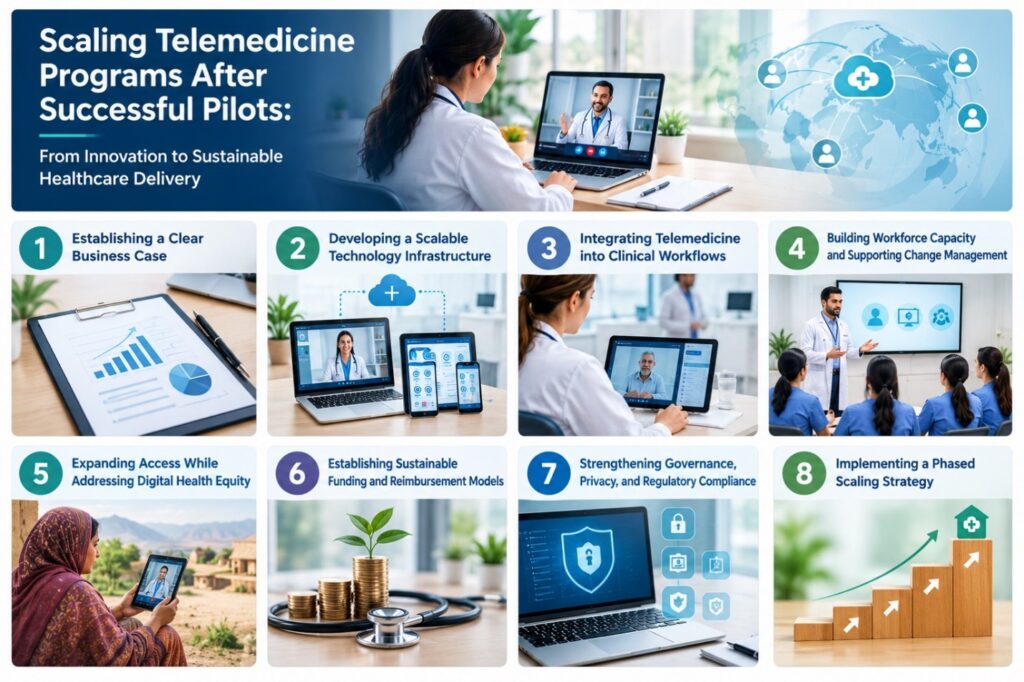
1. Establishing a Clear Business Case
Organizations should establish a baseline against which pilot results and future performance can be compared. They should also examine whether positive outcomes were attributable to telemedicine itself or to temporary pilot conditions, such as additional staffing, dedicated funding, or unusually intensive technical support.
A clear business case should identify the patient populations most likely to benefit, the services appropriate for virtual delivery, the resources required for expansion, and the expected return on investment. This evidence-based approach helps decision-makers prioritize investments and avoid scaling a model that performs well only under limited conditions.
2. Developing a Scalable Technology Infrastructure
Technology is a critical enabler of telemedicine, but a successful pilot platform may not be suitable for organization-wide deployment. Scaling requires infrastructure that is reliable, secure, interoperable, and capable of supporting growing demand. Some key components include:
3. Integrating Telemedicine into Clinical Workflows
One of the most common barriers to scaling telemedicine is the failure to integrate virtual care into established clinical processes. If telemedicine operates as a separate service with disconnected records, scheduling systems, and administrative procedures, it can increase workload rather than improve efficiency. Organizations should redesign workflows to incorporate virtual consultations into routine care. This includes appointment booking, patient triage, consent, pre-consultation preparation, documentation, prescribing, referrals, follow-up, and escalation to in-person services when necessary.
Standardized clinical protocols can help determine which patients and conditions are suitable for virtual care. For example, routine follow-ups, medication reviews, selected chronic disease management appointments, and certain mental health services may be appropriate for remote
delivery. Conditions requiring physical examination, urgent diagnostic procedures, or immediate intervention may require in-person assessment.
4. Building Workforce Capacity and Supporting Change Management
Scaling telemedicine requires more than providing clinicians with access to a digital platform. Healthcare professionals must be confident in delivering virtual care, using digital tools, communicating remotely, and managing clinical risk.
Training programs should address virtual consultation techniques, digital documentation, patient privacy, remote assessment limitations, technology troubleshooting, and appropriate escalation. Administrative teams also need training in scheduling, patient onboarding, troubleshooting, and reimbursement procedures.
Healthcare organizations should identify clinical champions who can demonstrate good practices, mentor colleagues, and communicate the benefits of telemedicine. Involving physicians, nurses, allied health professionals, administrators, and information technology teams in program design can improve adoption and reduce resistance.
Workload planning is equally important. Virtual consultations may require preparation, digital documentation, patient education, and follow-up activities that differ from those associated with in-person appointments. Staffing models should account for these requirements rather than assuming that remote consultations automatically reduce workload.
Continuous feedback, peer learning, refresher training, and responsive technical support can help establish telemedicine as a routine part of clinical practice.
5. Expanding Access While Addressing Digital Health Equity
A telemedicine program cannot be considered successful at scale if it primarily benefits patients who already have reliable internet access, modern devices, and strong digital literacy.
Digital exclusion can affect rural and remote communities, older adults, people with disabilities, individuals with limited language proficiency, and patients facing financial or social barriers. These challenges should be addressed early in the scaling strategy.
Practical measures include offering telephone consultations where clinically appropriate, designing accessible and multilingual interfaces, providing digital navigation support, simplifying registration, and enabling caregivers to assist when patients authorize their involvement. Partnerships with community health centers, libraries, and other appropriate community organizations may help patients access private spaces, connectivity, or technical assistance.
Organizations should also monitor utilization and outcomes across relevant patient groups. Differences in appointment completion, patient satisfaction, and clinical outcomes may reveal barriers that are hidden by overall program averages.
Equity should be treated as a core performance objective rather than an optional feature. A scalable telemedicine model should provide multiple ways to access care and ensure that digital delivery does not become a new source of healthcare inequality.
6. Establishing Sustainable Funding and Reimbursement Models
Financial sustainability is essential when moving from a pilot to routine operations. Pilot programs often benefit from temporary grants, innovation funding, donated technology, or additional staffing that may not be available during expansion.
A comprehensive financial plan should distinguish one-time implementation expenses from recurring operational costs.
One-time costs may include platform configuration, integration, cybersecurity assessments, equipment purchases, and initial training. Recurring costs may include software subscriptions, technical support, staffing, licensing, connectivity, maintenance, and ongoing quality assurance.
Revenue and reimbursement arrangements should be assessed alongside these costs. Organizations must understand applicable public or private payer policies, eligible service types, documentation requirements, and provider billing rules in the jurisdictions where they operate.
The financial analysis should also consider less visible benefits, such as reduced patient travel, improved follow-up attendance, better use of specialist time, and potentially fewer avoidable in-person visits. These benefits should be measured rather than assumed, and savings should be distinguished from cashable financial returns.
A phased funding strategy can help organizations expand services in line with demonstrated demand and available resources. Long-term sustainability is more likely when telemedicine is incorporated into operating budgets, contracting arrangements, and organizational performance plans instead of relying exclusively on temporary innovation funding.
7. Strengthening Governance, Privacy, and Regulatory Compliance
As telemedicine reaches more patients and clinical teams, the consequences of inconsistent practices become more significant. Organizations need clear governance structures to define accountability for clinical quality, technology performance, privacy, cybersecurity, and operational oversight.
A telemedicine governance framework should establish:
● Clinical eligibility criteria and standards of care.
Regulatory obligations vary across jurisdictions and may differ according to the location of the patient, the clinician, and the healthcare organization. Programs operating across regions should verify applicable requirements before expanding services.
Governance should not be viewed merely as a compliance exercise. It provides the structure needed to maintain consistent standards, protect patients, and preserve trust as the program grows.
8. Implementing a Phased Scaling Strategy
A phased approach allows healthcare organizations to expand telemedicine while managing operational risk and learning from implementation experience.
Phase 1: Validate and standardize
Phase 2: Expand to similar populations and services
Phase 3: Integrate across the organization
Phase 4: Expand based on demonstrated need
Phase 5: Optimize and continuously improve
Conclusion
Scaling telemedicine programs after successful pilots is an organizational transformation challenge as much as a technological one. Sustainable expansion depends on demonstrating measurable value, building reliable infrastructure, integrating virtual care into clinical workflows, supporting healthcare professionals, addressing digital inequities, and establishing appropriate governance and funding.